Friday, April 15, 2022

Duke Nukem Classics Collection on ZOOM Platform

Today, ZOOM Platform celebrates their 8th birthday, and what better way to celebrate it than with Duke Nukem. Welcome back to THE SITH ARCHIVES OF DARTH FANDOM, where I will be discussing a short history of what can be known as the “Duke Nukem Classics Collection”. In case you’re wondering, no, I’m not sponsored by ZOOM Platform, I just really like their site and have already bought quite a collection of games from them. To start things off, let’s go all the way back to 1991, to the release of Duke Nukem / Duke Nukum.

Apogee Software, at the time known for publishing id Software’s Commander Keen in Invasion of the Vorticons, released the first Duke Nukem game, a side-scrolling platformer in July of 1991. The story, set in 1997 (one of the only clear dates in the franchise), centres on Duke Nukem’s quest to take down the evil Dr Proton, who has built an army of Techbots and taken over Shrapnel City in Los Angeles. Over three episodes, Shrapnel City, Mission: Moonbase, and Trapped in the Future!, Duke Nukem defeats Dr Proton and saves the day. The 2.0 release of the game was renamed “Duke Nukum”, as Apogee were afraid of legal concerns due to a character in the animated series Captain Planet and the Planeteers being named Duke Nukem. However, the name was in fact not registered, so Apogee registered it for future titles. Duke Nukem was originally available on Steam and GOG (in a pack with Duke Nukem II), before being delisted in 2015. It was also included in The Duke Nukem Platformer Pack on Steam.

Duke Nukem was followed by a sequel, Duke Nukem II, in 1993. Taking a place soon after Duke Nukem, Duke has now written a book, Why I’m So Great, but gets captured by aliens (the Rigelatins) while promoting it. Duke defeats the aliens and escapes their base in a Skycar, on his way back to Earth. It contains four unnamed episodes, and sports Duke’s new look, with a red vest and metal clamps, a step up from his former pink clothing. Duke Nukem II released a Game Boy Color port, titled Duke Nukem, in 1999, changing some aspects of the story and gameplay, and a 20th Anniversary iOS remaster in 2013. The game was formerly available on Steam and GOG (in the Duke Nukem I+II Pack) and was included in The Duke Nukem Platformer Pack on Steam, before the Great Delisting of 2015.

Duke Nukem II’s 1996 sequel, Duke Nukem 3D, changed up the formula. While the first two games were side-scrolling platformers, Duke Nukem 3D was the series’ first step into First-Person Shooter territory, which the series is most well-known for today, thanks to Ken Silverman’s Build Engine. In December, 1996, 3D received the Plutonium PAK, an update available to the game that added a fourth episode on top of L.A. Meltdown, Lunar Apocalypse, and Shrapnel City, entitled The Birth. The Birth was also available in the Atomic Edition of Duke Nukem 3D. 3D also received tons of unofficial expansions, like its competitor Doom, as well as official ones. While GOG’s version included only the base game and the Plutonium PAK, the Steam version included GOG’s content, as well as the three major expansions, Duke it Out in D.C., Duke Caribbean: Life’s a Beach, and: Duke Nuclear Winter, along with the shovelware expansion Duke!ZONE II. Both of these were delisted in 2015. The game received many ports of over time, such as a PlayStation port (with content available unofficially for the PC version), a Nintendo 64 port (compatible with the Rednukem source port) and more. Duke Nukem 3D also received two new PC versions, Megaton Edition and 20th Anniversary World Tour.

Duke Nukem 3D: Megaton Edition is an official source port of Duke Nukem 3D, similar to what Shadow Warrior Classic Redux is to Shadow Warrior Classic Complete. It includes the base game, the Plutonium PAK, Duke it Out in D.C., Duke Caribbean: Life’s a Beach and Duke: Nuclear Winter. Megaton Edition was delisted from Steam in 2015, replaced by Duke Nukem 3D: 20th Anniversary World Tour, a new source port including a new fifth episode, Alien World Order. World Tour is exclusive to Steam, so there is no way to play Duke Nukem 3D on GOG.

In 2002, Duke Nukem: Manhattan Project was released, a spin-off with gameplay closer to the original side-scrolling games, albeit with 3D graphics. Manhattan Project essentially sees the return of Dr Proton, though as a different character named Mech Morphix. Morphix is causing havoc thanks to his radioactive slime, GLOPP, which is making mutant creatures pop up all over the place. The game was available on GOG and on Steam, as well as in Steam’s The Duke Nukem Platformer Pack. It received Xbox 360 port in 2010, and an iOS port in 2013, but the PC versions were delisted from both GOG and Steam during the Great Delisting of 2015.

After this, we got Duke Nukem Forever. Bleugh. However, ZOOM Platform is the only place to get the whole Duke Nukem Classics Collection, along with extra goodies! Duke Nukem I and II are available. Duke Nukem 3D comes with the base game, the Plutonium PAK, Duke it Out in D.C., Duke Caribbean: Life’s a Beach, Duke: Nuclear Winter, Duke!ZONE I/II, and Duke Nukem’s Penthouse Paradise (Duke It’s Zero Hour is in the works too). Duke Nukem: Manhattan Project also comes with the official level editor, and the classic 2001 trailer for what could have been the great Duke Nukem Forever. Plus, all four of the Duke games are on sale (25%) until the 17th! There’s no excuse not to get them. This wasn't one of my normal types of posts, just a quick announcement, but I do have some more stuff planned, most likely Duke-related as I've had to put PSP on hold. Well, keep on Duking and Nuking, that’s a wrap on THE SITH ARCHIVES OF DARTH FANDOM!

Sunday, April 10, 2022

What's Happening Now

Welcome back to THE SITH ARCHIVES OF DARTH FANDOM! Today is just a short post so that people know exactly what's going on right now:

  • The LCD panel in my main laptop is fried
  • My one USB is broken
  • I can't use my normal browser anymore (but my new one is better, thankfully)
  • I'm on a Duke Nukem marathon
  • I finished watching the Die Hard franchise
  • There's more stuff but whatever
That's basically what's been happening. Thanks to me not being able to use my "gaming" laptop, I've had to resort to my old Windows 7 laptop, which means that a lot of my content that I had planned for the blog is going to have to wait. I do have some posts planned to do with some recently leaked content, though, which I'm quite looking forward to. Well, that's a wrap on THE SITH ARCHIVES OF DARTH FANDOM!

Friday, April 1, 2022

Charity Shop Hunt #2 (30/03/2022) Recap

So, this post is a little different. Usually I’ve got a proper constructed post that I plan over a few days, but my LCD panel is apparently fried, so my laptop is awful to look at, and my internet’s been funny (not in the ha ha way) recently, so I haven’t been able to post anything on my blog. Currently I’m using my good old Windows 7 laptop, but that’s not the topic of today’s post. Just to clarify a couple of things, 1) this is not an April Fools post. Sure, it is April the 1st, but this stuff right here is fact. Also, I “went hunting” Wednesday (March 30), which isn’t a joke. 2) When I talk about a Charity Shop Hunt, it’s basically when I go around to all of my local charity shops to support them and find some cool and rare games along the way. 3) This is my first time blogging about it, but I have been Charity Shop Hunting before, so I’ll be referring to this as Hunt #2. Right, let’s get into it.

#1 Rayman 2: The Great Escape
Genre: 3D Platformer
Series: Rayman
Version: N/A
Release date: November 5, 1999
# of stores on: 2

#2 Project I.G.I
Genre: First-Person Shooter
Series: I.G.I
Version: N/A
Release date: December 8, 2000
# of stores on: 0

#3 Shellshock: Nam ‘67
Genre: Third-Person Shooter
Series: Shellshock
Version: N/A
Release date: September 3, 2004
# of stores on: 0

#4 Tom Clancy’s Rainbow Six Lockdown
Genre: First-Person Shooter
Series: Tom Clancy’s Rainbow Six
Version: Ubisoft Exclusive
Release date: February 16, 2006
# of stores on: 3

#5 The Club
Genre: Third-Person Shooter
Series: The Club
Version: N/A
Release date: February 7, 2008
# of stores on: 2

#6 Sniper: Art of Victory
Genre: First-Person Shooter
Series: Sniper
Version: Premiere
Release date: June 13, 2008
# of stores on: 4

#7 Madagascar: Escape 2 Africa
Genre: 3D Platformer
Series: Madagascar
Version: N/A
Release date: November 4, 2008
# of stores on: 0

#8 X-Men Origins: Wolverine – Uncaged Edition
Genre: Third-Person Hack & Slash
Series: X-Men Origins
Version: Super Hits
Release date: May 1, 2009
# of stores on: 0

#9 Epic Mickey 2: The Power of Two
Genre: 3D Platformer
Series: Epic Mickey
Version: N/A
Release date: October 6, 2014
# of stores on: 1

Well, there we have it. Charity Shop Hunt #2 was certainly a success. Hey, I even managed to snatch a copy of the E.T. film’s Special Edition DVD. Don’t worry, I’m not talking about the Atari game. It may not seem like a lot but my physical PC games collection is now at 25, with a little help from my Dad’s old bits and bobs. Well, that’s a wrap on THE SITH ARCHIVES OF DARTH FANDOM!

Sunday, March 20, 2022

Cruis'n: Arcade Racing ft. Doom and Fast & Furious

What's this? An arcade racing series that made its way to handhelds using the DOOM Engine? Welcome back to THE SITH ARCHIVES OF DARTH FANDOM, and today's topic is Cruis'n, a good old arcade racing series consisting of six games and a whole lot of fun. This post will span the Nintendo 64, Game Boy Color, Game Boy Advance, Wii, Switch and of course, arcade, all in the lead up to another special arcade racing post in the future. Without further ado, let's get cruis'n.

Cruiiiiiisiiiiin, yeah, Cruis'n USAAAAAA
Image credit: Arcade History

Cruis'n started back in September 1994, first appearing on Midway's V Unit arcade system, an arcade system consisting of only four games. Cruis'n USA, the first title in the series, is quite a simple game: pick a car, pick a track, drive. The game takes place across the USA, with you starting off in San Francisco and finishing the game in Washington, D.C. Cruis'n USA was one of two games, alongside Killer Instinct's original arcade version, to be part of Nintendo's "Ultra 64" lineup of arcade systems. Ultra 64 was eventually renamed "Nintendo 64" (the console we know today), and Nintendo ceased development for arcades. In December of 1996, Cruis'n USA was ported to Nintendo 64, albeit in a slightly different form, with a few differences: the woman who awards a trophy at the end of a race is wearing more clothes, some billboards were removed, killable animals were removed and Bill Clinton is no longer bathing with bikini girls in the back of a car. In March, 2008, Cruis'n USA was rereleased for the Nintendo Wii's Virtual Console, but before this comes the second installment in the original arcade trilogy.

Bye bye, Bill.
Image credit: Atlas Obscura

Cruis'n WOOO-OOOO-OOOOOOOOORLD!
Image credit: GameFabrique

November 1996's Cruis'n World is a vast improvement when compared to USA. While keeping the same overall style of gameplay, World is, as the title suggests, not just based in the USA. You get to race in 14 different countries (you even get to race on the Moon in the N64 version!), you have more cars to race in, up to four players can play in multiplayer and this game introduced stunts. World's June 1998 Nintendo 64 port was also more successful when compared to Cruis'n USA, and is widely regarded as the best of the N64 ports. World was the third of four games to run on Midway's V Unit system, after Cruis'n USA and War Gods, with the fourth and final title on the system being Off Road Challenge, the fourth title in Midway's Off Road series. Cruis'n World is the second game in the original trilogy of Cruis'n games, so let's talk about the third one.

War Gods has a playable character called Kabuki Jo. Awesome.
Image credit: VicioJuegos / YouTube

Just look at this flyer.
Image credit: Jtalledo / Wikimedia Commons
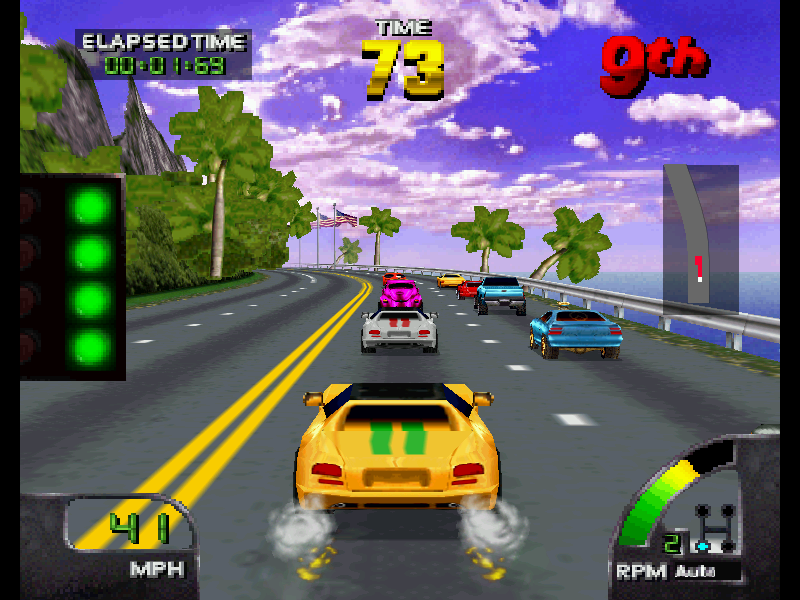
Cruis'n Exotica, released for arcades in 1999, is a strange game. As you can imagine, Exotica is an exotic game, and certainly changed the tone from relatively normal to all-out funky. No longer are you playing as an unseen driver hidden behind a black window in a 1963 Chevrolette Corvette, because you are now a Martian driving in some strange car with rocket boosters! Is driving on the Moon too silly for you? Well, you can drive in Atlantis, the dinosaur-infested Amazon and Mars! This third entry ran on Midway's Zeus II hardware, which was only use in one other game: The Grid, a 2000 arcade third-person shooter featuring some characters from the Mortal Kombat franchise. Exotica was also Cruis'n's debut title on handhelds, receiving a Game Boy Color on November 6, 2000. Developed by Crawfish Interactive, creators of some of my favourite Game Boy games (Street Fighter Alpha 3, Ecks vs. Sever and Ballistic: Ecks. vs Sever), Exotica on the GBC offers a similar experience to its N64 and arcade counterparts, albeit in a much more simplified and slightly less enjoyable way. Cruis'n Exotica marked the end of the Cruis'n series on Nintendo 64, but not the series as a whole.

It's not the worst, but there are certainly better GBC games and ports.
Image credit: GameFabrique

We got this...
...from this.
Image credits: World of Longplays / YouTube
Lee's Outlook / WordPress 

The Game Boy Advance saw the release of Cruis'n Velocity in November, 2001, which has quite an interesting story behind it. Velocity was developed by Graphic State, an English company who started off their business on the Game Boy Color with LEGO Stunt Rally. Their second released game, Cruis'n Velocity, ran on the engine being used for the then-in-development first-person shooter Dark Arena. Dark Arena's engine is a modified version of DOOM's Jaguar engine for GBA, which in itself is a modified version of the id Tech 1 engine. So, Cruis'n Velocity runs on the DOOM engine. Wow. If you've played Dark Arena, or even DOOM II on GBA, you may recognise some of the visual style and texture quality. In terms of gameplay, Velocity is better than Exotica's Game Boy Color port but still not quite as fun as the original N64 games. It's still quite strange why they would use a first-person shooter engine for a racing game when plenty of other racing games had come out perfectly on the GBA (V-Rally 3 is an excellent example), and the limitations of the DOOM engine do sometimes act as a detriment to Velocity as a whole. Well, that's DOOM covered. So how does Fast & Furious fit into the grand scheme of things?

Raw Thrills was formed in 2001 as an arcade game company, consisting of former Midway employees and starting off making gambling games. Raw Thrills' first title was Target: Terror, a 2004 light gun shooter for arcade systems that eventually saw release on the Nintendo Wii, published by Konami. Their second game was The Fast and The Furious, released in July, 2004, that sported oddly similar gameplay to the Cruis'n series. Like the film it is based off of, The Fast and The Furious received many sequels: The Fast and The Furious: Super Bikes, a bike-based game released in 2006; The Fast and The Furious: Drift, a game based off of the third film in the Fast & Furious franchise, released in 2007; and The Fast and The Furious: SuperCars, a spin-off released in 2010. SuperCars received a revision after the Fast & Furious license expired, and Super Bikes received two non-F&F sequels in 2010 and 2019, respectively. However, the original F&F game from 2004 received a Wii port in the form of Cruis'n in November, 2007. Cruis'n is essentially F&F 2004 but it's even worse and it's on the Wii. Well, that's Cruis'n on the Wii in a nutshell. Until 2017, it seemed like the Cruis'n series was over, but one more game was yet to be released.

Spot the difference.
Image credit: The Gaming and Hobby Channel / YouTube

Cruis'n's back.
Image credit: Best Buy

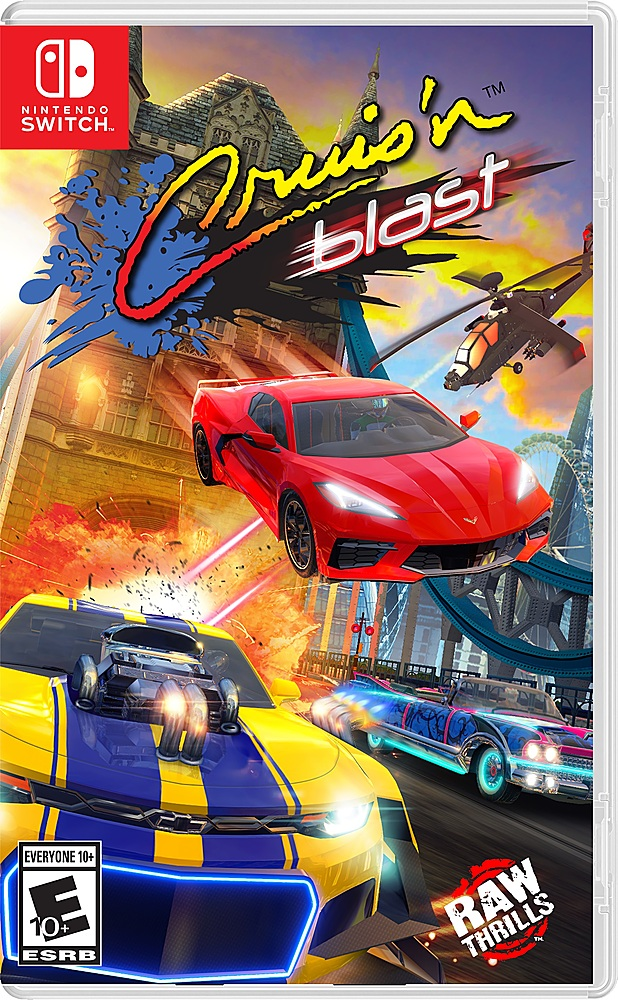
Cruis'n Blast is the latest game in the Cruis'n series, released in 2017 as Raw Thrills' 31st game. Being the first true Cruis'n game since 2001 (name changes don't count), Blast was quite exciting for Cruis'n fans. It added tons of new maps, tons of new cars, looks great graphically, the visual aesthetic is beautiful and it takes the silly factor of Exotica to a whole new level. Blast's 2017 version was good enough to receive a Nintendo Switch port, published by GameMill Entertainment (most well known for Big Rigs: Over the Road Racing) in September, 2021, almost 20 years since Velocity appeared on the GBA. Unlike previous arcade to Nintendo ports of the Cruis'n series, Blast adds in tons of new content, including 24 new maps. Never before have you been able to cruise (pun intended) through the streets of alien-invaded London as a Triceratops alongside a fire engine and a Pegasus. I'm not making that up. Cruis'n is truly at its peak with Blast, and it may be difficult to top it.

So that's the Cruis'n series, the first in a collection of blog posts on arcade racing series. I'm still divided on what I'm going to blog about next (trust me, there's a lot of stuff), but I hope that you enjoyed this blast, or should I say cruise, through the past. Well, that's a wrap on THE SITH ARCHIVES OF DARTH FANDOM!
**Cruis'n Blast is available on Nintendo eShop**

Saturday, March 12, 2022

From the Creators of Tomb Raider Comes... Streets of Rage?

You read the title. So... how exactly did Core Design, the developers of the original Tomb Raider games, make a Streets of Rage game? Welcome back to THE SITH ARCHIVES OF DARTH FANDOM, and today I'm going to be covering Fighting Force, a two-game series originally conceived as a 3D version of the Streets of Rage series that received one sequel that changed everything about the first game and caused a second sequel to be scrapped.

This in 3D.
Image credit: NME

Fighting Force was released back in October, 1997, a year after Core Design's hot new game Tomb Raider. Now, I will make a BIG confession here. I've never played ANY Tomb Raider games. I know, I'm a disappointment, but I will play the games some day. Anyways, Fighting Force was not always Fighting Force. As you can see in the title, Fighting Force was originally pitched to SEGA by Core Design as a Streets of Rage game and back then was intended as the fourth entry in the series (Streets of Rage 4 only came out in 2020, remember?), with a working title of "Streets of Rage 3D". However, SEGA declined the offer, saying that they were planning their own continuation of the SoR series (look how long it took for that to happen). No longer being constrained to the SEGA Saturn, Core Design rather moved to create a multi-platform title, which is where Fighting Force begins.

Turns out "3D Streets of Rage" WAS released... but it's just Streets of Rage on 3DS and still in 2D.
Image credit: Nintendo World Report

Core Design had Eidos back as their publisher, as they had with the original Tomb Raider the year before. This is where the final version of Fighting Force began production. The game was being developed for the original PlayStation, eventually to be ported to Windows, Nintendo 64 and SEGA Saturn, its originally intended platform. This was not how the chain of events played out, as the PlayStation (known in Japan as "Metal Fist", unrelated to Vivid Games' mobile game of the same name) and Windows versions were released, the Nintendo 64 and SEGA Saturn versions were nowhere to be seen.

Metal Fist!
Image credit: Retroplace

Fighting Force's Nintendo 64 version, entitled Fighting Force 64 like many N64 ports of the time, was originally shown off at E3 1998, though the game was cancelled by Eidos for unknown reasons. Los Angeles-based company Crave Entertainment bought the rights to Fighting Force 64 and released it in June 1999. The N64 has some differences to the main version, mainly graphical. As mentioned before, a SEGA Saturn version was also in production but was also cancelled, despite being completed. Eidos, like with the N64 port, dropped out of the Saturn port for unknown reasons, and SEGA Europe offered to publish the port but also dropped the idea in 1997. Luckily, in 2008, Hidden Palace contributor drx released a playable prototype of Fighting Force's SEGA Saturn port, entitled "Judgement Force". This was not the end of Fighting Force, though. The game was successful enough to be granted a sequel, and December 1999 saw the release of Fighting Force 2.

Hawk's final PSX rendition.
Image credit: Darius320 / YouTube

Hawk's original Saturn rendition.
Image credit: Hidden Palace

Fighting Force 2 is a drastically different game. Where-as the first game was a storyless, street beat-em-up, single-player and multiplayer game, Fighting Force 2 is a more grounded action-adventure game that follows a clearer story and, for some reason, removed the multiplayer. The sequel also only features one playable character, whereas the original featured four. Fighting Force 2 was only released on the original PlayStation and SEGA Dreamcast to rather negative reviews, killing the planned sequel. However, there is still enough information to piece together what could have been Fighting Force 3, so let's dive into it.

Doesn't look like Streets of Rage anymore.
Image credit: IGN

Fighting Force 3 began development in 2002, which saw the release of Core Design's PS2 platformer Herdy Gerdy and their GBA game Tomb Raider: The Prophecy. Planned to be released on PS2, Xbox and possibly the Nintendo GameCube, Fighting Force 3 returned to the first game's 3D beat-em-up style, while bringing back all characters back from the original and adding in Jill, a new playable character. It also would have features multiplayer again, something missing from the second game. Sadly, Core Design's June 2003 game Tomb Raider: The Angel of Darkness was unsuccessful and caused Fighting Force 3 to halt development and eventually be cancelled, eventually leading to Core Design's shut down a few years later. Unseen64 has quite a few screenshots and clips on Fighting Force 3, which you can find here.

That's more like it.
Image credit: Monokama / Unseen64

So that's Fighting Force, a failed 3D version of Streets of Rage that became an unsuccessful franchise, cancelled after its second game. I've got tons of upcoming posts planned, so keep watching this space. Well, that's a wrap on THE SITH ARCHIVES OF DARTH FANDOM!

Sunday, March 6, 2022

How to Play in English - Earth Defense Forces 2 Portable: A PSP Must Play

What's this? One of my favourite PSP games that is sadly only available in Japanese, finally playable in the English language? Welcome back to THE SITH ARCHIVES OF DARTH FANDOM, and today I will be discussing how to play Earth Defense Forces 2 Portable's English version. I would just like to thank Zenade, creator of the Tech Demo site and blog. He really was a massive help with this translation, but other than that, I have no idea what to right for an intro, so let's get right into it.

Step 1. Make sure you have an EDF2 Portable ROM

I'm not going to show you how to get an EDF2 Portable ROM. Go find out yourself.

Step 2. Download PPSSPP emulator for PC

Pretty simple, just click this link, extract to a folder of your choice and boom, you have the emulator.

Step 3. Set up PPSSPP

Once you've extracted the emulator, open PPSSPPWindows64.exe and this will install any last necessary files or folders. If you want, you can play around with some of the other settings as well, but only if you know what you're doing.

Step 4. Download HxD Hex Editor

Click this link, install and you've got your own hex editor up and running.

Step 5. Find your US EDF2.DAT file

Open your EDF2 ISO file (I would recommend using 7Zip), enter "PSP_GAME" folder, then "USRDIR", then "data" and finally "usa" folder. Here you should find a file "EDF2.DAT". Extract it and move on to the next step.

Step 6. Download VFS extractor and extract the .DAT

Click this link and extract its files to "
C:\VFS". Rename "VFSôWèJ" to "VFS" and move your extracted "EDF2.DAT" file to "C:\VFS". Drap and drop "EDF2.DAT" onto "VFS.bat" and you should see a cmd window pop up. After a few seconds, a folder should have appeared in "C:\VFS" called "EDF2".

Step 7. Sort the folders

In your EDF2 folder, find "MISSION016", "MISSION053" and "MISSION055" folders and delete them. Rename "_MISSION16", "_MISSION053" and "_MISSION055" to 
"MISSION016", "MISSION053" and "MISSION055", respectively. Delete the "MISSION044B" folder. Go back to where you extracted PPSSPP, enter the "memstick" folder and create a new folder called "EDF2 PORTABLE". Move the "GAMESEQUENCE" folder from "EDF2" into the "EDF2 PORTABLE" folder, and then create a new folder in "EDF2 PORTABLE" called "MISSION". From here, move all the "MISSION001"-"MISSION999" folders into "MISSION". Also create a folder called "WEAPON" in "EDF2 PORTABLE" and copy the "WEAPONCOMMENTLIST.VFS" file from "C:\VFS\EDF2\WEAPON" to "[PPSSPP folder]\memstick\EDF2 PORTABLE\WEAPON".

Step 8. Sort the last few files

Open HxD, select "File" and then "New". Make sure the box on the left of "Windows (ANSI)" reads "8". If not, select "8" from the dropdown list. Type in the number "0" until there are 8 dots (........) under "Decoded text". Save this file to "
[PPSSPP folder]\memstick\EDF2 PORTABLE\GAMESEQUENCE" as "MissionCommentList0.Vfs". Go back to the "[PPSSPP folder]\memstick\EDF2 PORTABLE\GAMESEQUENCE" and copy the "MissionCommentList0.Vfs" file 5 times, renaming the copies to "MissionCommentList1.Vfs", "MissionCommentList2.Vfs", "MissionCommentList3.Vfs", "MissionCommentList4.Vfs" and "MissionCommentListText.Vfs", respectively.

Step 9. Final setup

Open PPSSPPWindows64.exe and press "Load...". From here, find your EDF2 Portable ROM and open it. As the game is opening, press the Esc key and select "Cheats". Click on "Edit cheat file" and copy and paste the following text:

_C0 ENGLISH MISSION TEXT CODE

_L 0x20141B24 0x27A4FE00

_L 0x20141B40 0x0A200400

_L 0x20141B4C 0x8E040004

_L 0x20141DC0 0x34020000

_L 0x20001000 0x27BDFE00

_L 0x20001004 0x3C050880

_L 0x20001008 0x34A51038

_L 0x2000100C 0x0E24516C

_L 0x20001010 0x02203025

_L 0x20001014 0x02002025

_L 0x20001018 0x0E250730

_L 0x2000101C 0x27A50000

_L 0x20001020 0x10400003

_L 0x20001024 0x27BD0200

_L 0x20001028 0x0A250728

_L 0x2000102C 0x34020001

_L 0x20001030 0x0A2506D2

_L 0x20001038 0x6D746166

_L 0x2000103C 0x2F3A3073

_L 0x20001040 0x32464445

_L 0x20001044 0x524F5020

_L 0x20001048 0x4C424154

_L 0x2000104C 0x73252F45

_L 0x20001050 0x00000000

Save the file, press "Back" and then "Continue". After the "NOW LOADING" text disappears, press these keys using your preferred controller/keyboard: Circle, type in your name, START, Circle, DPAD-Left, Circle, Circle, Circle and then START. You should be at the main menu. Press the Esc key, select "Cheats", tick the "ENGLISH MISSION TEXT CODE" box, press "Back", press "Continue", press Circle, Circle, Circle, START, START, DPAD-Down, DPAD-Left, Circle. Press Circle again and your briefing should be English!

This was a bit of a rushed post, but I hope it's useful, and again, great thanks to Zenade. Well, that's a wrap on THE SITH ARCHIVES OF DARTH FANDOM!

Sunday, February 27, 2022

The Strange Case of World War Zero... or Iron Storm

What if the Great War never ended? What if it continued into the 1960s? How would the world's history unfold? Welcome back to THE SITH ARCHIVES OF DARTH FANDOM, and today I'm going to be talking about a PC First Person Shooter entitled Iron Storm. Or is it World War Zero? Or is it World War Zero: Iron Storm? This game has quite a strange history, involving closed down internet service providers, movie compression tolls, and, theoretically, FlatOut as well. But not FlatOut 3. We're not talking about FlatOut 3. So, let's start off at the beginning. What is Iron Storm?

Iron Storm is a First Person Shooter released exclusively for the PC, developed by 4X Studio and published by WanaDoo Edition. Both of those names will probably sound quite unfamiliar, so I'll explain. 4X Studio was a games development subsidiary of 4X Technologies, mostly known for middleware software (video compression, game engines, etc.), formed in 2002 and shut down only months after. Iron Storm was their first game, and two other games were also in development, Stalingrad and Times of Trouble. These games, however, were never released, as 4X Studio shut down soon after the release of Iron Storm. WanaDoo Edition was a subsidiary of French internet service provider WanaDoo (now part of Orange), who began publishing games in 2000 until being bought up by Microids in 2003 and eventually stopping publication of games in 2005. What happened next?

Lovely game.
Image credit: Z Mighty 1 / Fandom

Coinciding with the release of Iron Storm was a browser Flash game, tentatively titled, well, Iron Storm, but it's not really great. Just a typical Flash shooter. What is interesting though is that Iron Storm was meant to receive a sequel, most likely titled Iron Storm 2, that was in development in 2003. Due to 4X Studio being shut down, this game was never released, but many of its assets were used to create a spiritual successor under a new name. After the closure of 4X Studio, its employees moved on to create a new company, Kylotonn, who are well known for their various racing games, including their upcoming Test Drive Unlimited Solar Drive game. However, in 2005, when they were but a new, unknown company, Kylotonn released their first game, an alternate history FPS by the name of "Bet on Soldier: Blood Sport".

Just another Flash shooter game.
Image credit: ironstormpc / ModDB

While Iron Storm focused on a "What if World War One never ended?" scenario, Bet on Soldier: Blood Sport puts the spotlight on a World War set during the 1990s, where soldiers fight in 1v1 deathmatches that are televised worldwide as "Bet on Soldier", a popular show that money people gamble on. What is interesting is that the game makes many references, both verbally and visually, to Iron Storm, even saying that this world has been in a war for 80 years. Ironically, that's around the time of World War One. BoS then received two expansion packs which act as prequels to the main game, centering on the stories of two characters from the game. This was the end of 4X Studio/Kylotonn's war story, but that's not the last of Iron Storm.

Gambling for survival? You tend to shoot more than gamble in this game.
Image Credit: GameFaqs / GameSpot

A year before the release of Bet on Soldier, in 2004, Rebellion Developments, the people behind the AvP First Person Shooters, the Sniper Elite series and its spin-off series, Zombie Army, developed World War Zero: Iron Storm for the PS2. World War Zero is a remake of Iron Storm, featuring two new things: enhanced graphics and a couple of new weapons. Is that it? No, the remake removed quick saving, it removed third person mode, it removed most of the cutscenes, and IT REMOVED THE MULTIPLAYER. Now I will tell you that World War Zero received a PC port the next year, but you know what? It is still missing quick saving, still missing third person mode, still missing most of the cutscenes, and still missing the multiplayer. 2004 had Half-Life 2, it had Far Cry, it had Halo 2, it had Doom 3, it had CS:S, it had UNREAL TOURNAMENT 2004. Do you think PC shooters should have omitted multiplayer at the time? Of course not. That's enough of my ranting.

I thought it was just called AvP.
Image Credit: Rebellion / Valve

Well, that's the story of Iron Storm. Or World War Zero. Or both. In case you're interested in actually knowing what the game is like, rather than the stories surrounding it, I would recommend watching Jarek4's video here. I think that's enough for today. But just as a head's up, next time I have something EDF-related planned that may make some people happy... Well, that's a wrap on THE SITH ARCHIVES OF DARTH FANDOM!

**Iron Storm is available on ZOOM Platform, GOG and Steam**
**World War Zero is available on Steam**
**Bet on Soldier: Blood Sport is available on Steam and GamersGate**

Saturday, February 12, 2022

Coded Arms: Assault - The Cancelled Sequel to My Favourite PSP Game

What's this time? Time for me to discuss my favourite PSP game ever made? Half yes, half no. Welcome back to THE SITH ARCHIVES OF DARTH FANDOM, and, in my ongoing quest to blog about my favourite PSP games, I was planning on making a post on Coded Arms, a First-Person Shooter published by Konami, that happens to be BOTH the first FPS on the PSP AND the first roguelike on the PSP. There are a couple of other interesting things that Coded Arms achieved first, but that's not the subject of today's blog post. Just over two months after the release of Coded Arms on the PSP, Konami released Coded Arms: Contagion, another PSP-exclusive FPS that continued the story of the first game. However, until two days ago, I was yet to learn that Coded Arms had a PS3-exclusive sequel in the works entitled "Coded Arms: Assault".

The original Coded Arms.
Image Credit: LewisLongshanks

Coded Arms: Assault is one of those games that sadly hasn't had a leak yet. As of now, there is no playable demo available online, so all of my info for this post is from roughly 2005-2007. To start off with the basics, Coded Arms: Assault was its own thing. I'm okay posting about the cancelled sequel first because it essentially only shares the name and very rough premise, that premise being that you are a hacker-solider who is hacking into a virtual world for profit. To start things off, I'll be covering the basic plot elements that have been released. These are only confirmed points, as I will be speculating some things:

  • The game takes place within Kagura, a virtual version of Tokyo
  • You are a skilled hacker who has been hired to steal data from the Ashihara Corporation
  • The enemies in the game are essentially the firewall of the Ashihara Corporation
  • You will meet other hackers who are trying to steal the same data
  • You will meet a professor who helped create the virtual world that the games takes place in
  • You will meet a mysterious female hacker whose mission is to eliminate "visitors" into Kagura
  • The mysterious female hacker is ambushed by three armed soldiers at one point
  • The real world is being affected by what is happening within Kagura
  • People are dying in the real world because of the situation in Kagura
  • Kagura can be accessed using the TokyoWars_20.07 drug
The mysterious female hacker.
Image Credit: NeoGamer

So, these are some points that I've put together using various articles and clips. I still need to compile sources, but you should be able to find these articles and videos by searching for Coded Arms: Assault. Now that we've got the pure facts over and done with, let's move on to some theories I have about the game's story.

  • The female hacker has the number "03" on her armour. Could this mean that she is one of the original hackers in her group?
  • The AI of the Kagura system is self-aware but tells the player character that "this is not a virtual game world". Is Kagura another dimension or something more than a virtual reality system entirely?
  • The player character is seen fighting a giant, green-eyed creature made of headless naked bodies in one trailer. Could this creature be the manifestation of people who have died in Kagura, or are these soldiers working for the Ashihara Corporation?
  • The female hacker states that the player character is "kind of different". Could this be because he has survived the virtual world thus far, unlike other hackers?
  • The previous theory is backed up by showing the player character with three other hackers wearing the same armour. Did they not survive the Kagura system?
  • The female hacker says that "eliminating visitors is [her] mission", yet she is seen being attacked in the same trailer by people who don't look like the player character. Are these people security guards for the Ashihara Corporation, or are they other hackers trying to get the data like the player character?
  • The female hacker says "My warning is for all visitors infiltrating Kagura. This isn't a game. There's real death here". Do people who die in Kagura die in the real world, and is this causing all the strange occurrences in the real world?
  • The female hacker has a voice line saying "they're dead. In the real world". Does the player character have a family that has died due to his actions in Kagura, or are these the other hackers seen with the player in the screenshot mentioned earlier, following the previous theory?
The mentioned screenshot.
Image Credit: Yota/Unseen64

Well, those are some story theories of mine. In terms of gameplay, the game was being developed on the Unreal Engine 3, and would've been a First-Person Shooter. It most likely was not procedurally-generated, but rather a linear, story-based game. Two trailers were revealed for the game, and two playable demos were available at E3, as far as I remember. Hopefully this game will have at least one playable demo someday. Well, that's a wrap on THE SITH ARCHIVES OF DARTH FANDOM!

Sunday, February 6, 2022

Initial Ramblings - Earth Defense Forces 2 Portable: A PSP Must Play

Ugly graphics, unstable frame rate, quantity over quality and inconsistent gameplay. These are all characteristics of a bad game. Welcome back to THE SITH ARCHIVES OF DARTH FANDOM, and today, I'm going to be changing things up a bit. Yes, I know, it's been MONTHS since I last posted, and, yes, I do ALWAYS tend to post an "I'm back" blog whenever I'm, well, back, BUT THIS TIME, I may have found a working routine for my blogging scheme. So, let's jump right into it.

Video gaming is a massive part of our modern culture. You may be obsessed with Call of Duty, adore Pokémon, or just love driving around some famous area in Forza. No matter, most people have played, made or enjoyed games for a very long time, and that isn't going to stop any time soon. You've constantly got new console generations being rolled out one after the other, each with their own exclusives and cross platform games. That's enough of that, though. Handheld gaming has been around for a long time, too, mainly being a Nintendo thing, but eventually expanding into the microtransaction-filled world of mobile gaming. Nintendo had their GameBoys, DS's, Switches, etc., Nokia had the disaster child N-Gage, and Sony had the PlayStation Vita. I mean, there was also the PlayStation Pocket, but whatever. However, my personal favourite of the Sony handhelds is the PlayStation Portable, better known as the PSP, which is home to tons of my favourite games, one of which I shall be talking to you about now.

Yep, that's the one.
Image Credit: Evan-Amos, Wikimedia Commons.

If you're a Japanese gamer from the PlayStation 1 era and you are constantly looking out for bargains, you've probably heard about the Simple Series. For those of you that haven't, the Simple Series was a, well, simple series. Designed solely to be a quantity over quality experience, the Simple Series would provide gamers with a new and simple game every 4 months or so, gradually increasing the price in Yen for each Series. The PlayStation 1 had the Simple 1500 Series (costing 1500 Yen), the PS2 had the Simple 2000 Series (costing 2000 Yen), etc. etc. Originally these games would be, I know, simple, usually a remake of something classic, like a sport or popular card game. Sometimes you would get lucky and find an all-new original title, which is where Monster Attack comes in.

You read that right, this is the 93rd game in the series.
Image Credit: D3 Publisher, Amazon

Monster Attack was game #31 out of #107 (do you see what I mean about quantity over quality?) in the Simple 2000 Series, and offered a strange experience, something in the vein of a B-Movie. You are part of the Earth Defense Force, a group defending the Earth from all sorts of threats, including aliens who ironically look identical to Earth's insects and other little creatures. I won't talk much about Monster Attack, as it's a subject that I may cover in another blog post. Monster Attack did eventually receive a slightly altered version in Europe, and was later remade as Earth Defense Force 2017 (EDF3 in Japan), being the first game in the series to be released outside of Japan or Europe. EDF2017 was later rereleased on the PlayStation Vita, and more recently on the Nintendo Switch, albeit exclusively in Japan. A sequel to Monster Attack was eventually released two years later as Simple 2000 Series Vol. 81, known in Europe as Global Defense Force.

Look no further than the box art to see how strange this game is.
Image Credit: Agetec, Retroplace

Global Defense Force (or "The Chikyū Bōeigun 2" for the extremists) didn't change that much of the basic gameplay from Monster Attack. What it did add was a second playable character, larger maps and more variety in terms of weapons and aliens. Being part of the Simple 2000 Series, GDF was a PlayStation 2 exclusive, later receiving a PAL port for the same console. Unlike Monster Attack, in 2011, GDF received a PSP port titled "Earth Defense Forces 2 Portable", extremely late into the PSP's life span (in fact, it would only be 8 months until the Vita was released in Japan), although it was exclusive to Japan, despite the original PS2 version being available in Europe as well. I recently got my hands on Earth Defense Forces 2 Portable (quite a mouthful, but expected for Japanese games), and that's where today's history lesson ends.

Attack of the Killer... Ants?!
Image Credit: GameSpot

As I said in the beginning of this post, EDF2 should be a bad game. It has the characteristics of one, and I was expecting nothing at all. Well, I was kind of excited, knowing that D3Publisher also published Demolition Girl and Dead Head Fred (the latter of which is an excellent game in my opinion, while the former is, well, strange, and something that I'll hopefully discuss sometime soon). I was pleasantly surprised. I don't own a physical PSP, but rather use the PPSSPP emulator. In fact, I don't own any consoles, I'm really a Windows guy. First off, I'll talk about the story. There is none. Well at least to me, because I don't speak Japanese, and the PS2's English translation was not used for the PSP version. That's where the next interesting thing comes in: What lies inside the game's files?

There will always be a spot in my heart for Demolition Girl.
Image Credit: GameFabrique (please don't use their site, they give you malware)

Here is where I'll recommend you take a read of Zenade's post on EDF2 Portable (just click on the text). Zenade has a HUGE write-up of cheat codes for the game, and managed to find files for the English translation. He even gave a tutorial on how to use it! Sadly, he has only written up on how to use this translation on an actual PSP, but I have reached out to him to see if he knows how to use the translation on the emulator. Please, give Zenade's article a good read, and now, back to the game.

According to Zenade, you can do this.
Image Credit: Zenade

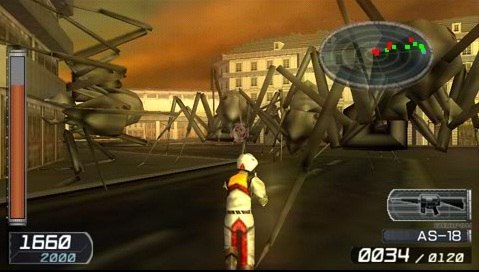
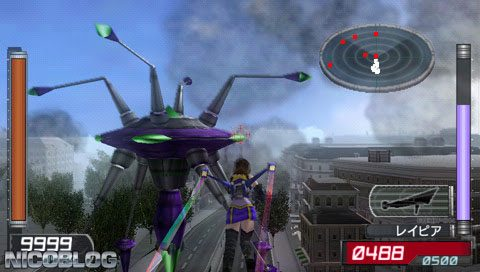
EDF2P (no, not that F2P) is a simple game, so even if you are clueless about Japanese text, you should be able to figure out how to play. The game has something like 80 single player missions, which can be played by two different characters, a male and a female. Both can be used for different strategies, and both can use different weapons. Also available for gaming pleasure is a multiplayer mode, which is incredibly fun and really enhances the gameplay. In terms of enemies, from what I've played so far, I've fought giant ants, giant spiders, giant FLYING ants, UFOs, Quadpods, laser dish thingies and Godzilla. I'm not kidding. The maps are quite large, and vehicles are often present, which are quite fun to use in grassy areas. So far, I have found tanks, a jet ski sort of thing (it looks like it's straight out of Jet Moto, a PS1 favourite of mine) and a helicopter, which I used to mow down flying saucers. This game truly is awesome. So, is this game good?

This game is lovely.
Image Credit: Spike, CDRomance

Now, I'm not one to usually use ratings out of 5 or 10. I prefer to just say whether something's amazing, great, good, bad, awful or horrendous. EDF2P is not the best game, far from it in fact. What it is though is a truly fun game that never fails in making me have fun. I would say that this is a PSP gem, and is definitely something that you should take a look at if you are interested in shooters, PSP or just games in general. I quite enjoyed rambling about EDF, so hopefully I'll be able to do the same in the future, be it Coded Arms (my favourite PSP game), more EDF or something else. Well, that's a wrap on THE SITH ARCHIVES OF DARTH FANDOM!

**EDIT (06/02/2022)** It turns out that Monster Attack was remade (source), and the post has been edited to reflect this. **/EDIT**